Welcome back Stargazers!
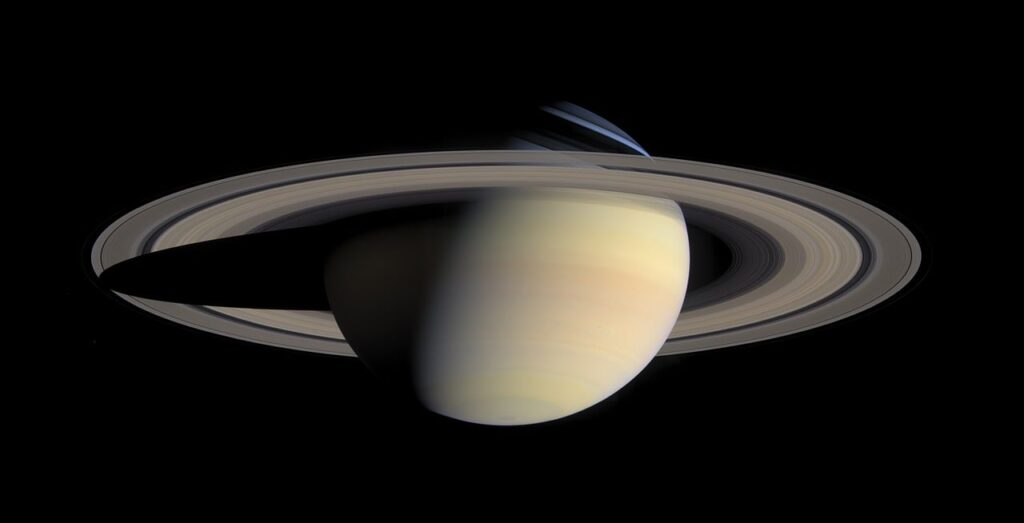
We’re going to visit the magnificent gas giant famous for its massive ring system, the sixth planet from the Sun – Saturn. Similar to its cousin, the gas giant Jupiter, Saturn is a massive ball made mostly of hydrogen and helium. Even though there are other planets with rings, none are more striking or as complicated as Saturn’s. And after a visit from the multi-country-invested space probe – Cassini – curiosity turned to discovery of dozens of moons orbiting this sleepy giant.
The farthest planet from Earth discovered by the unaided human eye, Saturn has been known to exist since ancient times. Saturn is named for the Roman god of agriculture, wealth and as the father of Jupiter. It’s also known as the planet of boundaries, time, and structure.
Unfortunately for space colony enthusiasts, Saturn’s environment cannot support life as we know it. The temperatures, pressures and materials that characterize this planet are most likely too erratic and turbulent for organisms to survive. While Saturn is not supportive of living things, that may not be true for some of its many moons. “Satellites” like Enceladus and Titan are homes to oceans and could possibly support life.
Saturn’s moons hold many secrets and mysteries while providing a treasure trove of scientific knowledge. Recent discoveries of jets of water? that spray from Saturn’s moon Enceladus to the methane lakes on smoggy Titan, is just one example of the efforts to uncover the knowledge of these moons.
Saturn is approximately 9 times larger than Earth; if the Earth were the size of a nickel, Saturn would be about as big as a volleyball. The average distance from the Sun to Saturn is 886 million miles and it takes sunlight 80 minutes to travel from the Sun to Saturn. A typical day on Saturn takes 10.7 hours, which makes it the second shortest day in the solar system. A year in the life of Saturn is about 10,756 Earth days or about 29.4 Earth years. Both Earth and Saturn experience seasons, as the axis tilt is similar for both planets.
Project Cassini (1979) helped discover another aspect to this planet – the Moons of Saturn. It’s home to a vast array of intriguing and unique worlds. Saturn has 274 confirmed moons in its orbit, far more than any other planets in our system. And doubtless there are countless other Saturnian “satellites” waiting for discovery and official naming.
The most recognizable trait of Saturn is its rings! These are believed to be pieces of comets, asteroids, or shattered moons that broke up before they reached the planet’s surface. Some pieces are as big as a house or a mountain, and there are billions of small chunks of ice and rock coated with other materials like dust. Each ring orbits Saturn at different speeds and extends up to 175,000 miles above the planet. The rings are relatively close together and named alphabetically in the order by which they were discovered.
Saturn is similar to Jupiter in makeup – mostly hydrogen and helium, the same as the Sun. The core is also similar to Jupiter’s – iron and nickel, surrounded by rocky material. Fun Fact: Saturn is the only planet in our Solar system with an average density that is less than water. (This huge planet could float in a bathtub if such a gigantic item existed.)
The atmosphere is mostly clouds that appear as faint stripes, jet streams and storms. Saturn itself appears to be different shades of yellow, brown and gray. Its magnetic field is smaller than Jupiter’s but 578 times as powerful as Earth’s.
Much of this and more information we now have about Saturn has come to us by way of Cassini, a flagship robotic spacecraft that spent more than 13 years orbiting the planet. These years provided photos, samples and a ton of information about the ringed planet and its complex ecosystem. This unique spacecraft was launched in 1997, and it was a joint mission between NASA, the European Space Agency and the Italian Space Agency. But Cassini stopped sending signals and in 2017, NASA deliberately “plunged” the spacecraft into Saturn’s atmosphere to avoid possible damage to one of its rings.
The importance of the Cassini spacecraft and its discoveries is that we realize there are potentially oceanic worlds throughout the solar system, dramatically expanding the search for extraterrestrial life. By discovering globally-wide liquid oceans (water?) and hydrothermal vents on Enceladus, and active methane seas on Titan, Cassini proved that life-supporting conditions can exist far from our sun……
Keep looking towards the heavens! Keep wondering about the secrets the gentle giant planets hold. And know that over the next two weeks, we have several unique celestial events: today, June 29 is the full micro Strawberry Moon and Mercury goes retrograde (sigh – until July 23); June 30 is International Asteroid Day; and July 3, Mars and Uranus are “ultra close” – this occurs an hour before sunrise. Take an early walk and watch the planets dance.
Yours in the Stars!
Astrid