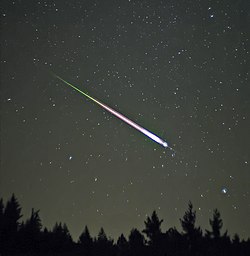
Welcome back Stargazers! We’re quickly advancing to the Winter Solstice with the speed of a shooting star! Two exciting events occur during mid-December for us to observe and enjoy. The celestial heavens will start the show with the Geminid Meteor Shower (Dec 13-14), followed by the Winter Solstice (Dec 21).
The Geminid Meteor Shower produces the best star event of the year, as it’s known for its bright, often colorful meteors. The conditions this year will be quite favorable for viewing, since there’s a smaller, less brilliant moon prior to this event. This will allow stargazers to see up to 120 meteors per hour. Folklore surrounding these shooting stars goes back to the Roman myth of the “tears of the Twins” as well as relating astrological myth to the Gemini constellation. Astronomers named the Asteroid responsible for the displays ‘Phaethon’ because its orbit brings it closer to the Sun, thereby causing the asteroid to lose matter, creating the meteor showers when the Earth passes through the debris. Geminid displays are unique as they come from an asteroid instead of a comet. This makes them a “marvel of space science,” showing how our planet interacts with space rock.
Those shooting stars do appear to come from near the stars Castor and Pollex in the Gemini constellation, leading to the name “tears of the Twins.” (Castor and Pollex are the twins born of Jupiter and Lida in Roman mythology.) Therefore, being linked to the sign of the Twins, the meteor showers are also associated with communication, curiosity and new ideas. Shooting stars are seen as powerful omens. They represent ‘wake up calls’ – encouraging individuals to find their purpose, or seize the chance to literally wish upon a star. Since this star shower happens in mid-December near the Winter Solstice, it will coincide with themes of rebirth and a new year.
Days prior to Christmas, we enter the Winter Solstice, marked as the shortest day and the longest night of the year, symbolizing death and rebirth, the triumph of light over darkness, and a period for introspection and renewal. Ancient cultures, dependent on the sun for survival, created rich folklore to explain this special, annual celestial event and offers hope during the darkest time of the year. The unusual theme of the “rebirth” of the sun, encouraged many ancients to celebrate the birth of their solar deities, including Ra in Egypt and Apollo in Greece around the Solstice.
In Northern Europe during the Winter Solstice, there’s the Yule feast to celebrate the Sun’s return. Traditions like the burning of the Yule Log (symbolizing the sun’s fire and good harvest) and decorating with evergreens (representing eternal life) are traditions that influence present-day Christmas customs. The Celtic tradition also celebrates with the symbolic battle where the Oak King, representing the glowing light, defeats the Holly King who embodies the fading darkness. The Oak King’s victory ensures the return of longer days.
The beginning of the Winter Solstice ushers in the quiet of falling snow and the glow of soft lights, and is considered the ideal time to reflect on personal growth, the release of old patterns, and to prepare for the future year. This time of year is also associated with the “gate” through which departing souls pass, while the Summer Solstice (Cancer or Moonchild Season) is considered the “gate of arrival” for souls. Overall, the folklore and astrology of the Winter Solstice converge in the theme of a powerful turning point. Embrace the darkness and stillness as an important part of a cycle that will ultimately lead to the predetermined return of light, hope, and new beginnings. Keep looking to the Heavens and enjoy their beautiful display of wonder.
Be sure to make a wish on the “falling stars” of the Geminid Meteor Shower!
Happy Stargazing until next time.
Yours in the Stars,
Astrid